Google Ads vs Bing Ads and why we use both in Ireland
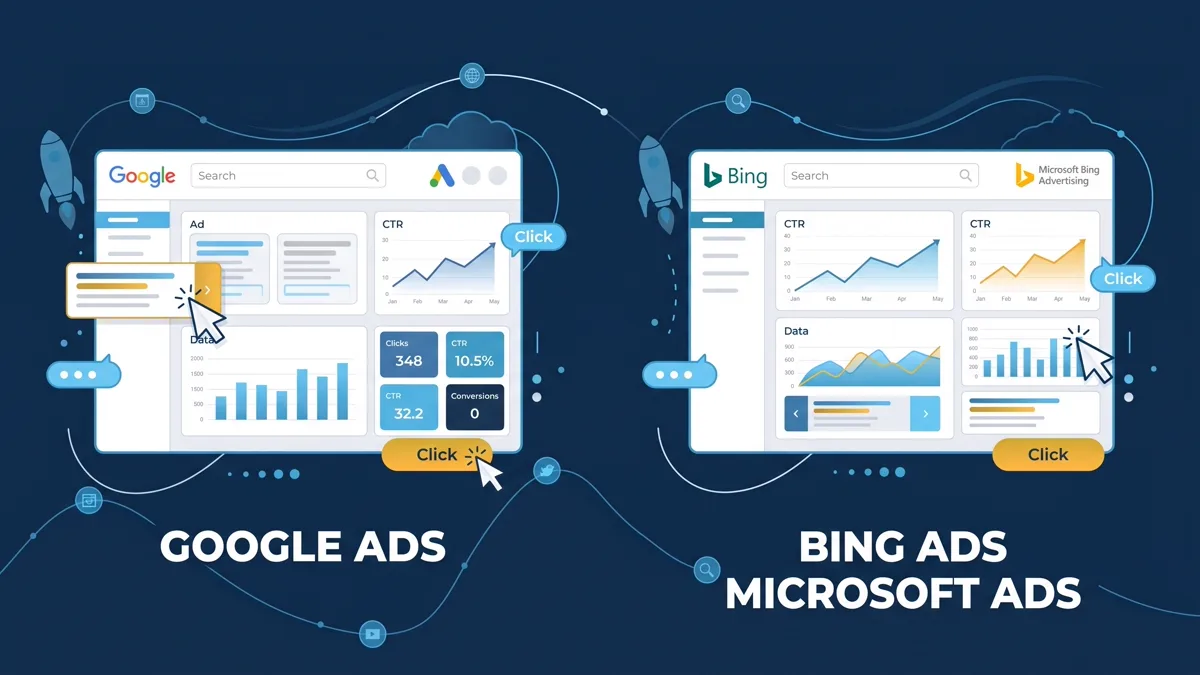
Our ideal strategy is to use Google Ads and Bing Ads together. Google gives us the reach to find out which searches lead to paying customers. Bing gives us a way to reach people making those same searches elsewhere. One visit to an office brought that home for me.
Who actually uses Bing?
I was in the office of the vice president of the CPA. He booted up his computer, opened his browser to look something up, and there was Bing. It was his search engine. If I’d been running ads only on Google, I’d have missed him on that search.
I think about that when a business owner asks me who uses Bing. If you sell to older customers with money to spend, or to senior people who make buying decisions at work, it’s worth finding out how many of them you can reach there. One visit to an office stuck with me. The cost of winning an actual customer is what decides whether I keep spending.
How much smaller is Bing in Ireland?
In October 2026, Google accounted for 92.98% of Irish search engine market share and Bing for 4.62%, according to Statcounter. For a roofer advertising in one county, the difference matters. Even if Bing produces a cheaper enquiry, there may only be a handful of relevant searches in a week. These market shares measure search engine use. Your actual ad impressions depend on the search terms, area and targeting you choose. Statcounter’s Ireland figures for October 2026.
What about competitors clicking your ads?
If a competitor in your town wants to see who’s advertising, my hunch is they’ll check Google first. That gives Bing an interesting upside: your ads may attract fewer clicks from people in the trade who have no intention of asking for a quote. You can’t tell who clicked simply because a visit didn’t convert. I’d check how many clicks became qualified enquiries before putting a saving against it.
Fewer jobs can still mean a better CPA
Here’s how I’d compare the two for a window installer. These figures are illustrative. Say Google brings in six booked jobs for €1,200. That’s €200 per job. Bing brings in two jobs for €240. That’s €120 per job. Google delivered more work. Bing had the better cost per acquisition (CPA), saving €80 on each customer it brought in.
Assume both kinds of job leave €500 each after materials and fitting. After ad spend, the six Google jobs contribute €1,800 and the two Bing jobs contribute €760. I’d keep buying those two Bing jobs for as long as the numbers held up, even if there weren’t enough searches to bring in a third.
How to run a fair test
- Start with one service and one area. Compare searches for replacement windows in Kerry on both platforms. Send visitors to the same page and keep searches for your business name separate.
- Count the same outcomes. Track calls and forms, then record which enquiries qualified and which became jobs. Allow time for quotes to turn into sales before moving the budget.
- Know your ceiling. If a job contributes €500 before advertising and one in five qualified enquiries becomes a job, €100 per qualified enquiry is break-even before overheads. Your target needs to leave room for profit.
How we use Google Ads and Bing Ads together
For a window installer, I would start with the Google search terms that have already led to booked installations. If replacement windows in Kerry is one of them, I would run that search on Bing alongside the Google campaign and send visitors to the same quote page. That gives us a chance to win an extra installation from someone who opens Bing first.
I would judge the expansion by how many additional jobs we book and what we pay to win each one. If Bing keeps bringing in profitable work, it earns its own budget. Google can still account for most of the spend.
Explore our Google Ads management and Bing Ads management services, or see how search costs varied by county in the Weather Master Kerry case study.